Complete guide for workshops in Quebec
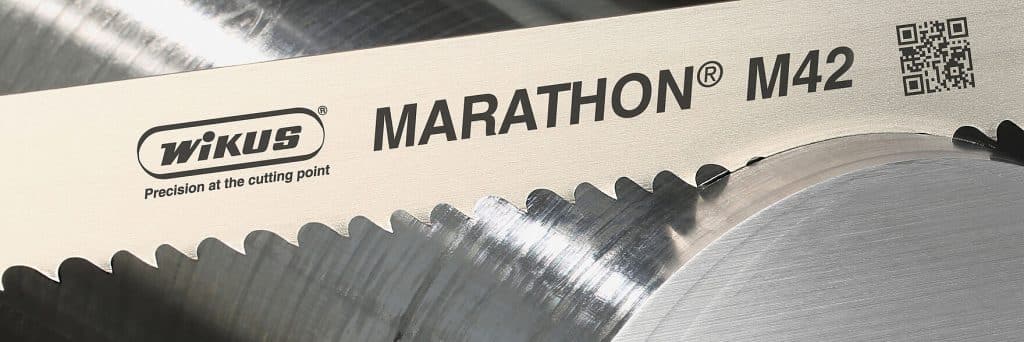
Looking for a band saw blade for cutting steel, aluminum, or stainless steel? Whether you're a machine shop, service center, or manufacturing company, choosing the right blade can make all the difference in terms of productivity and cut quality. This article explains everything you need to know, based directly on the expertise of Wikus Canada—one of the world's leading manufacturers—and gives you direct access to their smart blade selector.
1. What is a metal band saw blade?
A metal band saw blade is a toothed steel band wound in a loop, designed to make precise cuts in various metals. It is used on a horizontal or vertical band saw, depending on the type of workshop. These blades are specially designed to withstand the stresses of cutting hard materials and maintain a long service life.
There are several types of blades, each designed to meet specific needs:
- Bi-metal blades : composed of a flexible steel body and high-speed steel (HSS) teeth. These are the most common type, ideal for most ferrous and non-ferrous metals.
- Carbide blades : equipped with tungsten carbide teeth for cutting very hard materials such as stainless steel, refractory alloys or hardened parts.
- Diamond Grit Blades : recommended for extremely abrasive materials such as graphite, glass, ceramics or certain composites.
Each type of blade has its advantages depending on the application. Choosing the right model optimizes productivity, cut quality, and tool life, while reducing operating costs.
2. How to choose the right band saw blade?
Here are the main factors to consider:
- Teeth per inch (TPI) : The higher the TPI, the finer the cut, but the slower it is. Ideal for thin metals. A low TPI is perfect for thicker pieces.
- Tooth shape : Wavy, regular, variable… Each geometry has its purpose. Variable profiles reduce vibrations and extend lifespan.
- Cutting speed and feed rate : These parameters must be adjusted according to the material and the blade chosen.
- Machine type : Vertical, horizontal, semi-automatic or automatic? This influences the type and size of the blade.
- Materials to cut(taking thickness into account) :
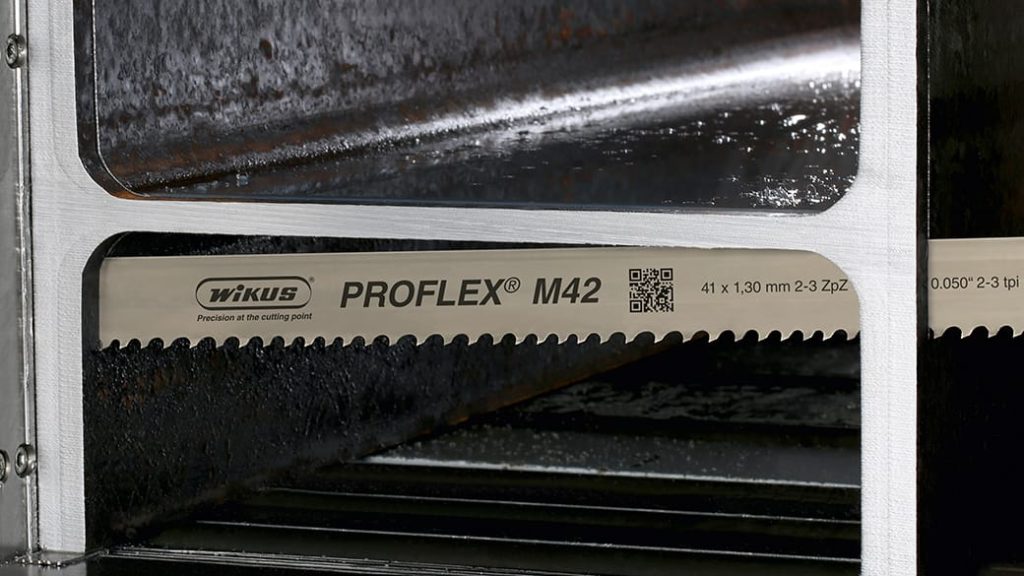
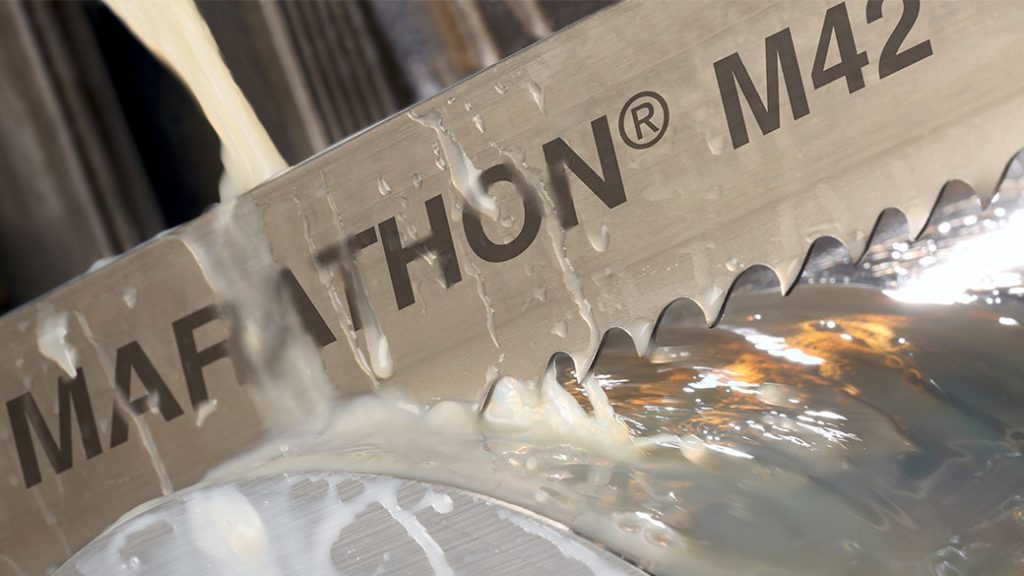
- Mild steel : bimetal blade with variable tooth pitch (e.g., MARATHON M42/PROFLEX M42/Primar M42), TPI depending on the diameter – see table below or use the Wikus selector
- Stainless steel : reinforced carbide or bimetal blade, with TPI adjusted according to thickness
- Aluminium : positive toothed blade, TPI generally higher for thin walls
Use the Wikus Canada blade selector to choose the perfect blade :
Access the blade selector
Quick overview – TPI recommendations by application
| Main material | Shape (● filled / ◯ empty) | Approximate dimensions | TPI recommended |
| Mild steel | ● | 1/2″ to 1″ | 6–10 |
| Mild steel | ● | 1″ to 3″ | 4–6 |
| Mild steel | ● | 4″ to 6″ | 3–4 |
| Mild steel | ● | 6″ to 10″ | 2–3 |
| Mild steel | ◯ | Wall thickness 1/16″ to 1/8″ | 10–14 |
| Mild steel | ◯ | Wall thickness 1/8″ to 1/4″ | 6–10 |
| Stainless steel | ● | 1/2″ to 1″ | 8–12 |
| Stainless steel | ● | 1″ to 3″ | 6–10 |
| Stainless steel | ● | 4″ to 8″ | 3–4 |
| Aluminum | ● | 1″ to 2″ | 6–10 |
| Aluminum | ◯ | Wall thickness 1/16″ to 1/8″ | 10–14 |
| Aluminum | ◯ | Wall thickness 1/8″ to 1/4″ | 6–10 |
| Steel mechanical tube | ◯ | Thin wall (<3/16″) | 14–18 |
| H, L profiles or angles | ◯ | Wall 3/16″ to 1/4″ | 6–10 |
| H and L profiles, angles or thick mechanical tubes | ◯ | Wall >1/4″ | 4–6 |
These recommendations are based on technical data from Wikus Canada and inspired by industry best practices. Actual performance may vary depending on the machine, cutting parameters, and operating conditions. For optimal results, use the Wikus blade selector or contact Raymond Robert Machinery for personalized advice .
3. Frequently Asked Questions (Technical FAQ)
-
What is the average lifespan of a blade?
There is no single lifespan, as a blade's longevity depends heavily on the type of material, cutting parameters, lubrication, and machine maintenance. A well-chosen blade used under good conditions can make hundreds of precise cuts , while an unsuitable or poorly maintained blade can wear out very quickly. As a general rule:
Bi-metal blades offer excellent versatility and a satisfactory lifespan for most applications.
Carbide blades, which are more rigid and heat-resistant, are preferred for difficult materials and high-volume cutting. -
Why does my blade break so quickly?
– Incorrect TPI for the application
– Incorrect voltage
– Unsuitable speed
– Inadequate cooling -
When should I replace my blade?
– If the cut becomes noisy or uneven
– If the blade deviates
– If the teeth are rounded or broken -
How do I properly maintain my blade?
– Clean the chips regularly
– Use a suitable cutting fluid
– Follow the recommended settings
4. Why choose Raymond Robert Machinerie for your blades?
- Local expertise : Proximity, rapid availability and personalized service throughout Quebec.
- Personalized technical support : Our experts help you choose the right blade for your cuts, depending on your equipment and application.
- Official partner of Wikus : We represent one of the best blade manufacturers in the world, with direct access to their highest performing models.
- Local inventory and fast delivery : Several models are available for fast delivery, anywhere in the province.
5. Request your price now
Need a specific blade or technical advice?
Contact us for a quick quote:
Contact us or call us directly at 514-935-3589 .
To conclude
We will help you select the most cost-effective blade for your operations.
Whether you are cutting HSS, stainless steel, copper or carbon steel, choosing the right band saw blade is essential to improving your cutting times, finish quality and tool life.
Trust Raymond Robert Machinerie to provide you with high-performance, tested blades adapted to your industrial needs in Quebec.
Still have doubts? Our team will help you find the most cost-effective solution based on your cutting method and production goals.